Vanishing Schools, Threatened Communities
  • Paperback ISBN: 9781552664018
  • Paperback Price: $24.95 CAD
  • Publication Date: Apr 2011
  • Rights: World
  • Pages: 200

Buy Now!

Examination Copy

Professors/Instructors in Canada: We will provide examination copies of our books for consideration as course texts. We do reserve the right to limit examination copy requests and/or to provide books on a pre-payment or approval basis. For examination copy requests from USA, UK and Europe, please see our Ordering Page. For requests from all other countries—shipping charges will apply.

Request Examination Copy

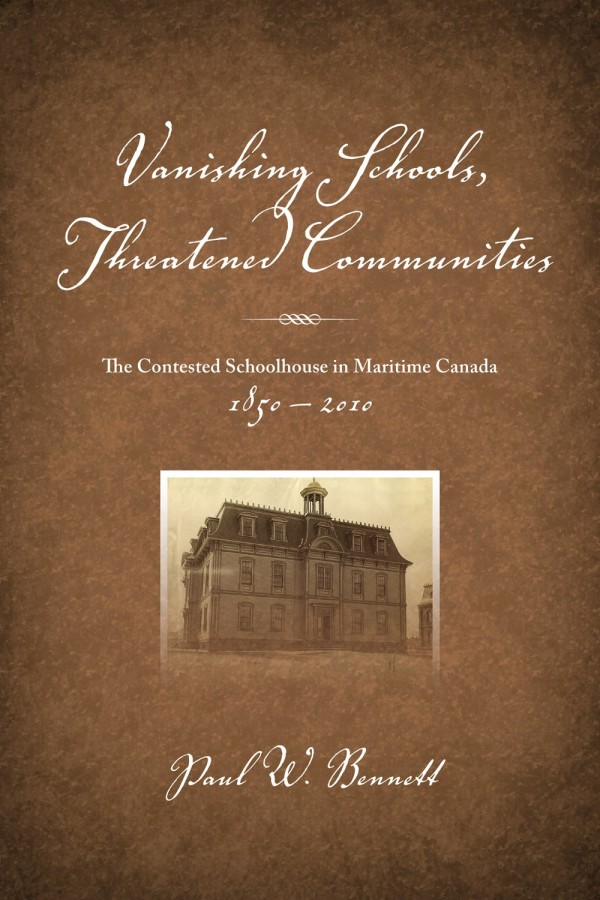
Vanishing Schools, Threatened Communities

The Contested Schoolhouse in Maritime Canada 1850–2010

Paul W. Bennett

Traditional schoolhouses and neighbourhood schools are disappearing at an alarming rate, making way for ”big box” schools that serve multiple communities and adhere to the logic of modernization, centralization and uniformity. In Vanishing Schools, Threatened Communities, author Paul W. Bennett explores the phenomenon of school closures, focusing on Maritime Canada from 1850 until the present day. Here is a lively, stimulating book that examines the rise of common schooling from one-room schoolhouses that encouraged local democratic control through to the rise of “super-sized” schools governed by a vast bureaucracy that silences public participation. Though the public has not always remained silent, local ”save our schools” movements have not succeeded in halting the march of ”progress.“ Bennett sets out, in this colourful history of schools, to remind us of the principles that formed the basis of the public education system and urges us to return to these principles in order to better serve the needs of our children and our communities.


Contents

Foreword • Introduction • Schoolhouses and Communities — An Endangered Heritage • The Advent of the Modern Education State • Rural Schools: The One-Room Schoolhouse • Urban Schools: “Palaces” of Victorian Canada • Modernization: Surviving the Onslaught of Progress • Consolidation, Bureaucracy and the People • Retrenchment: Declining Enrolments and School Closures • System Under Stress: The School Savers and Their Mission • Epilogue: Restoring and Humanizing Public Education • References • Index

About the Author

Paul W. Bennett, Ed.D. (OISE/Toronto), is a Halifax author and an independent educational policy consultant. His previous books include The Grammar School: Striving for Excellence in a Public School World (2009), Canada: A North American Nation (1995), Years of Promise, 1896–1911 (1986) and Emerging Identities: Problems and Interpretations in Canadian History (1986), co-authored with Cornelius J. Jaenen. 

Excerpt

Download PDF

Reviews

Scholarly Look at Emotional Issue (Chronicle Hearld)

Author traces Nova Scotia’s education history: Why communities lose their schools and the growth of the system’s centralized bureaucracy


The history of education in Nova Scotia is a subject that has not attracted a great deal of systematic attention. Now, Halifax scholar Paul Bennett has written Vanishing Schools, Threatened Communities: The Contested Schoolhouse in Maritime Canada 1850-2010.

 There have been only a few academic theses and obscure archival tracts that have attempted to map the province’s educational history. The thing about educational history is that everyone over a certain age is an “expert.” There are many educational histories, as many as there were children in those historic schoolhouses. Sometimes this is an unhappy story and we are finally hearing buried accounts of multiple abuses and restrictions that schooling represented for marginalized populations. But there are other stories told around kitchen tables, in clubs, service organizations, church groups, and in workplaces. The story tends to be thickly drawn with nostalgic images of long walks home through egalitarian communities, the camaraderie of youth, good-natured mischief, feats of memory, and stern but competent teachers.

 Typically, this folk history is the story of the descent of a once great system into the depths of chaos and underperformance. Often this history is peppered with an equally caustic analysis of the increasing costs of running schools, declining enrolment notwithstanding.

 Bennett seems not to disagree entirely, but his analysis is both nuanced and informed by historical evidence and research into present-day school wars in rural Nova Scotia. The theoretical thread that holds Bennett’s history together is the idea that Nova Scotia’s educational system has followed the North American model and become increasingly centralized and bureaucratized. His analysis shows how the state comes to play an ever-expanding part in education, which propels centralization at all levels. Small schools are consolidated into larger ones, local school boards are consolidated into district and regional boards, teachers are professionalized, and, most importantly, communities lose control of their schools.

 This loss of control plays into the decline of rural communities already challenged by multiple forces of urbanization, economic restructuring and social and political change. Unlike most analyses of contemporary education, Bennett’s book highlights the rural, recognizing that a significant proportion of Nova Scotia’s population continues to live in the countryside.

 Vanishing Schools, Threatened Communities is one rare attempt to explain why schools have evolved as they have. It is a complex story written in an accessible style. Bennett’s analysis takes into consideration both time and space, which is why I think this book is important both for scholars and for those who question the cosy, commonplace folk history of schooling.

 Bennett’s book contextualizes the development of the school from small, largely rural, one-room 19th-century operations to the present day. Through the 20th century, Bennett demonstrates how the purely functional village schoolhouse morphed into the town-based academies and “palace schools” that served as monuments to education for growing towns and cities.

 Bennett clearly loves these schools, their architecture, and what they represented in terms of public respect for education. By the 1950s and 60s the contemporary secondary system emerged with the establishment of rural high schools and more modern generic “shopping mall” high schools that were built for baby boom students, but also to accommodate the novel expectation that most young people ought to complete high school regardless of their social origins (which incidentally is a big part of the reason why schooling isn’t as cheap as it used to be).

 Finally, we arrive in today’s Nova Scotia with a new wave of school construction that Bennett characterizes as big-box or “airport” schools complete with tight security and runways for the province’s academically inclined youth to “take off” for the big city.

 But, of course, the historical narrative is not a simple line from big to small. The image of the airport high school sits in contrast with the considerable attention Bennett devotes to many community struggles to save village schools. History matters, but so does place.

 Bennett situates the historical trajectory of the development of schools and schooling within the geography of a province that has remained more rural than most Canadian jurisdictions. While only about 20 per cent of Canadians live in rural places, about 45 per cent of Nova Scotians live in the country.

 Thus, the historical shift from small, locally controlled rural schools to large, centrally administered urban schools has been slower to develop in this province. However, most of the bureaucratic models for school governance, curriculum and assessment have been developed for a system that is largely urban.

 The development of modern schooling and the rise of an increasingly bureaucratized system are generally understood to be an historical phenomenon, but I think the real strength of Bennett’s book is in the way that he shows how the transformation of schooling is caught up with the uneven development of Nova Scotia. He documents the mismatch between bureaucratic centralization and multiple battles for community survival.

 Bennett argues that small communities continue to matter and that education is a key location for ongoing popular struggles, which are essentially about people fighting to keep their home places and established ways of life alive against a tide of mobilization, standardization, consolidation and homogenization.

 At the beginning of the 20th century the German sociologist Max Weber wrote that bureaucracy is a dehumanizing and inefficient system of governance that grew up as population came to be heavily concentrated in urban spaces. The trouble is (he wrote) that it is the best method yet devised for the management of large numbers of people, and without bureaucracy, contemporary life melts down into a desperate mess.

 The question that Bennett’s book raises with respect to education is whether or not Weber was right. He suggests that it may be possible for us to imagine alternative educational governance structures, which are less bureaucratic and more open to local control.

 An important problem that Bennett’s book does not significantly address though is the way that the bureaucratic expansion of public education has also attempted to create the conditions for a system that includes all children and that has begun to make attempts to serve populations who were absent from the cosy nostalgic folk narrative of the old time schoolhouse (which again, is why it is now more expensive).

Bureaucracy may be a terrible thing, but do we have a better alternative? Bennett seems to think we do. Observing the madness of privatization and quasi-privatization schemes, voucher systems, and charter schools in the United States and in Britain, I am not so sure.–Michael Corbett for Herald Books, Sunday July 31, 2011


(Close)

Book Defends small schools on the Island

 The Eastern School Board’s contentious decision to close eight schools is prominently featured in Halifax author Paul Bennett’s recently published book, Vanishing schools, Threatened Communities: The contested Schoolhouse in Maritime Canada. Mr. Bennett’s background includes 34 years of working in the education system in Ontario, Quebec and Nova Scotia, including 20 years in administration. He retired as headmaster of the Halifax Grammar School in 2009 before establishing the Schoolhouse Consulting firm. He currently writes on education issues in the Halifax Chronicle-Herald.

Mr. Bennett said the project initially started as a book about school closures, but after doing a lot of background research on the issue, “it ended up being a full study on what I call the lies of the bureaucratic education state in the maritimes.”

He said the book is a history of education in the Maritimes beginning in the days of the one-room schoolhouse, and up to the modern school system and the changes that have taken place in that system, with the overall purpose to raise people’s historical consciousness and to defend rural community schools.

”Bureaucratization and consolidation is leading to uniformity and the crowding out of public participation in the school system,” Mr. Bennett said.

He said PEI’s education history is well represented in the book including reflections from Dr. Edward MacDonald of UPEI, as well as an overview of Premier Alex Campbell’s Comprehensive Plan that included school consolidations back in the 1960s. The history goes to the Eastern School District’s closure of eight schools back in 2009 and as recently as the infamous November 2010 Eastern School Board meeting which eventually led to Education Minister Doug Currie’s disbanding of the elected board, to be replaced by a single appointed trustee.

”It shows there is something really seriously dysfunctional there. The book makes a very strong case that local democracy in education is threatened. We need to stand up and fight to revitalize the school system.”

Mr. Bennett’s research includes stories from The Eastern Graphic and the book includes quotes from columns written by publisher Paul MacNeill on the actions of the province and the Eastern School Board.

Mr. Bennett interviewed Peter Llewellyn who was a major voice of opposition of the school closures. He said Mr. Llewellyn is an interesting figure who along with the PEI Rural alliance practiced a form of “radical populism” with the goal to return power to the people in the rural areas. He said the group’s efforts were “the last stand of rural community schools” in the Maritimes. He contrasts the Rural Alliance’s efforts with the Save the Community School effort currently taking place in Antigonish county, Nova Scotia.

”It’s not quite a radical (in Antigonish)_. They’ve (the school district) identified three or four schools at a time and try to pick them off. You’ve got more of a broader scale consolidation going on, so it’s more intense.”

Mr. Bennett will be signing copies at the indigo bookstore in Charlottetown Tuesday, May 24 from 2 to 4pm and will be at Beaconsfield’s Carriage House at 7pm.–David MacDonald, The Guardian Wednesday May 18, 2011.


(Close)

Author Says Quality of Education, Not Infrastructure, Is What Matters

When it comes to education, bigger doesn’t mean better, and maintaining schools is essential to maintaining communities, says a Halifax author.

Paul Bennett launched his book Vanishing Schools, Threatened Communities: The Contested Schoolhouse in Maritime Canada at the York Sunbury Museum on Monday night with a talk about why community schools are important during a time when talks of closing small schools dominates the public education agenda.

“Educators are great organizers ... They always think first of organizing and managing people and directing them to their purposes. That’s why in spite of the fact people keep saying, ‘Why aren’t children first in education?’ It’s because the adults tend to focus more on structure, centralization and organization,” he said.

“You get a much more efficient system, but one that doesn’t allow as much public participation. The student-teacher relationship is critical. People are getting further and further removed from that relationship.”

Bennett’s research indicates New Brunswick is the most advanced province in the Maritimes in terms of moving toward centralization following the decision to abolish school boards in 1996.

He said the problem with a centralized system comes down to the effect it has on accountability. Like in a small town, people know one another when they come from a small school.

As a result, he said, there’s a greater interest to ensure children do well.

“Like you worry if a child doesn’t read. You don’t just say, ‘We’ve got reading recovery. Dump them over there’ ... It’s an argument for community schools and their future. We’ve got to find a structure that allows them to flourish,” he said. “The best accountability is that of a teacher, a parent and a student, and if you erect structures and organizations between them, there’s less accountability.”

The other problem Bennett sees in New Brunswick comes down to how decisions are arrived at related to school closures.

He said the formula doesn’t take the quality of education received at small schools into account and that in many cases, the attention a child receives from a teacher means more to parents than the physical resources that are available.

Will van den Hoonaard, a member of the Save Our School-Douglas group, said he corresponded with Bennett via email before he arrived in Fredericton and agrees with him on the role of the school and the community.

“I love his idea of the big-box schools. To me, I myself talk about warehousing–warehousing children and people. I really don’t like that,” he said.

Regarding discussions about the Douglas school, van den Hoonaard said the group met with the Education Minister Jody Carr last week to talk about the future of the school, and although the situation is delicate, it feels good about the way it went.

“We brought our findings and our research, so we’re waiting for his decision and we’ve done all we could,” he said. “So we’re at a time where we’re waiting, and hopefully, he’ll make a good decision.”

Bennett said the group should make sure it’s prepared to fight for the school.

“Learn the rules and understand school closure process, and if you have a lawyer in your community, make sure that you have him at your side,” he said.

“School boards spend an incredible amount of money on legal advice, they might spend $100,000 to close a school. So you’re no match for them.”–Tara Chislett, Daily Gleaner, Tuesday May 31, 2011

(Close)

Book Examines Loss of Traditional Schoolhouses for ‘Big Box’ Institutions

The May 4 launch of Paul Bennett’s new book, ‘Vanishing Schools, Threatened Communities,’  came on the eve of an important announcement.
Ben Levin’s review of the province’s public education system was officially unveiled the next day. Levin’s many recommendations included cutting the number of teaching assistants and school closures to deal with declining enrollment.
The timing couldn’t have been better for Bennett. The publisher (Fernwood Publishing) describes ‘Vanishing Schools’ as a look at how traditional schoolhouses and neighbourhood schools are rapidly disappearing in exchange for “big box” schools.
Although he initially intended to write about the impact of school closures nationwide, Bennett quickly realized very little had been written about the impact this has had on the Maritimes.

With the exception of one PEI educator who wrote in the late 1960s and a New Brunswick PhD thesis dating back to the 1970s, Maritime-based research material was spartan at best so Bennett focused his efforts here.
“When I met with Errol Sharpe (Fernwood’s co-publisher), he said he liked the concept but half the equation was missing,” Bennett recalled. “I had the schools, but what about the communities?”
That comment shifted his focus, and Bennett began looking at the impact school closures had on individual communities. His research was far reaching, and the result is a history of “the contested schoolhouse in Maritime Canada” stretching from 1850 to 2010.
“I had to write the history and the background. What emerges is a full history of education in the Maritime provinces,” he explained. “It was a huge undertaking.”
While the one-room schoolhouse of past generations was an integral part of the community and encouraged student and parental participation, Bennett believes the bureaucracy governing today’s “super-sized” schools is detrimental to the community and silences public participation.
He points to a school superintendent who in 1880 warned that although the education system began as education for all, it was becoming education good enough for all. Bennett follows the shifting architectural styles of schools. From the one room schoolhouse to the garden-variety one level school, the rise of the “big box” elementary school, change wasn’t always progress.
He describes the “shopping mall” high schools of the 1980s and works his way to Citadel High, which he describes as “airport terminal high.”
“The changes in architecture reflect the priorities of the system, from the beginnings of strictly teachers and pupils with parents directly involved at all levels to the centralized, bureaucratized system where the public has little or nothing to do with the school,” he said.
Bennett was pleased that Levin’s report released last week reflected his argument that the system does not exist for its staff, but for students and families.
Despite his concerns, Bennett does have hope for the future. He believes that society is  now recognizing the need to return to the principles that formed the public education system.
“What really mattered right from the beginning were small community schools, good teaching and teaching for character,” he said. “In the 21st century returning to these principles is a good place to start.”
‘Vanishing Schools, Threatened Communities’ is available at independent and chain bookstores throughout HRM.–Yves Dentremont, Halifax News Net

(Close)