- Paperback ISBN: 9781552664438
- Paperback Price: $24.95 CAD
- Publication Date: Sep 2011
- Rights: World
- Pages: 232
Buy Now!
Examination Copy
Professors/Instructors in Canada: We will provide examination copies of our books for consideration as course texts. We do reserve the right to limit examination copy requests and/or to provide books on a pre-payment or approval basis. For examination copy requests from USA, UK and Europe, please see our Ordering Page. For requests from all other countries—shipping charges will apply.
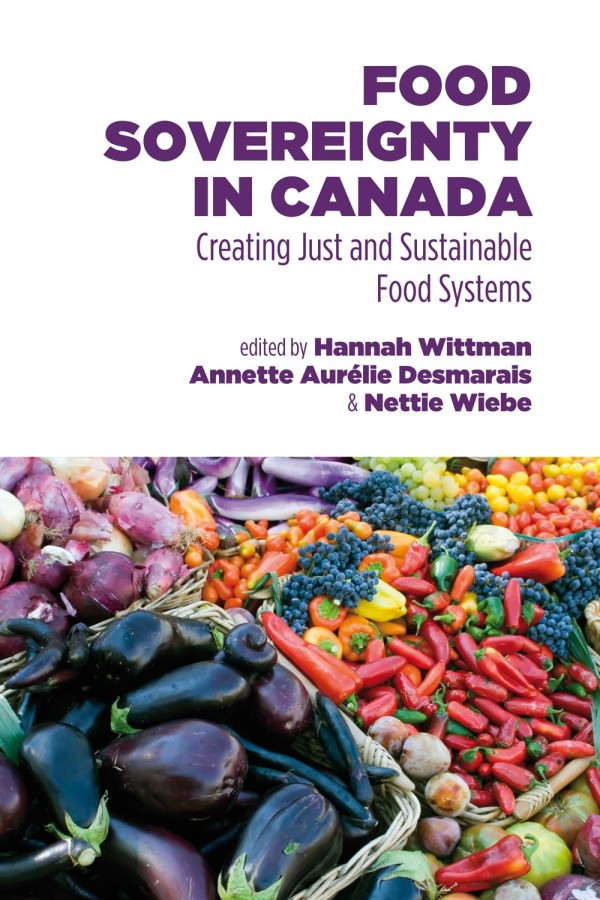
Request Examination CopyFood Sovereignty in Canada
Creating Just and Sustainable Food Systems
Edited by Annette Aurélie Desmarais, Nettie Wiebe, Hannah Wittman
Contemporary Canadian agricultural and food policies are contributing to the current global food crisis: the industrialized, high-input, export-driven agricultural production sector, coupled with concentrated corporate processing and retailing, are ecologically unsustainable, increasingly unaffordable, unhealthy and socially unjust. Employing an interdisciplinary and multi-sectoral approach, Food Sovereignty in Canada explores how communities all over the country are actively engaged in implementing alternative agricultural and food models within the framework of food sovereignty — taking control over food-producing resources, markets and agricultural policy. This framework offers Canadian citizens, researchers and policymakers the opportunity to build alternative agricultural and food models that are less environmentally damaging and that keep farmers on the land while ensuring that those living in cities have access to healthy and safe food. Achieving food sovereignty requires conceptual and practical changes, reshaping menus, farming, communities, relationships, values and policy, but, as the authors clearly demonstrate, the urgent work of building food sovereignty in Canada is well under way.
In case studies of practical action, Food Sovereignty in Canada provides an analysis of indigenous food sovereignty, orderly marketing, community gardens, the political engagement of nutritionists, experiences with urban agriculture and the strengthening of links between rural and urban communities. It also highlights policy-related challenges to building community-based agriculture and food systems that are ecologically sustainable and socially just. This book is essential reading for anyone interested in holistic, healthy and sustainable food production and consumption.
Contents
Section 1 – Why Should Canada Pursue Food Sovereignty? – Nurturing Food Sovereignty in Canada (Nettie Wiebe & Kevin Wipf) • The State of Agriculture in Canada and the Need for Food Sovereignty (Darrin Qualman) • Food Sovereignty and the National Farmers Union: Grassroots Issues and Challenges (Naomi Beingessner) • Women Farmers Define a Food Sovereignty Policy for Canada (Annette Aurélie Desmarais, Carla Roppel & Diane Martz) Section 2 – Implementing Food Sovereignty – Community Nutrition Practice and Research: Integrating a Food Sovereignty Approach (Rachel Engler-Stringer) • Food Secure Canada: Where Agriculture, Environment, Health, Food and Justice Intersect (Cathleen Kneen) • Growing Community: Community Gardens as a Local Practice of Food Sovereignty (Yolanda Hansen) • Food Sovereignty in the Golden Horseshoe Region of Ontario (Harriet Friedmann) • Indigenous Food Sovereignty: A Model for Social Learning (Dawn Morrison) • The Limits of Farmer Control: Food Sovereignty and Conflicts over the Canadian Wheat Board (André Magnan) • The Potential for Food Sovereignty in British Columbia: Food Regime Contradictions and Local Resistance (Hannah Wittman & Herb Barbolet)
About the Authors
Annette Aurelie Desmarais was a farmer for 14 years. She has a MA in Gender and Development from the Institute of Development Studies, University of Sussex and received a PhD in Geography from the University of Calgary. She is currently Associate Professor in the International Studies Program at the University of Regina. Her key areas of research are food sovereignty, globalization and agrarian change, rural social movements and social justice, development theory and practice, gender and international development. She is currently involved in on-going research with the international peasant and farm movement, La Vía Campesina.
Annette’s book La Vía Campesina: Globalization and the Power of Peasants was nominated for the Chadwick F. Alger Award and the Lionel Gelber Prize; it has been published in French, Spanish and Italian. She was awarded the Eric Wolf Prize by the Journal of Peasant Studies (JPS) for the article entitled “The Vía Campesina: Consolidating an International Peasant and Farm Movement.”
Annette is a member of the International Advisory Board of the Journal of Peasant Studies and the Editorial Board of Human Geography. She is a Research Associate with the Centro de Estudios para el Cambio en el Campo Mexicano (CECCAM), Mexico City. Annette is also on the Advisory Committee of the Centre Europe – Tiers Monde (CETIM, Geneva) and the Resource Rights Advisory Committee–Grassroots International Resource Rights for All, and is an Advisor to the International Programme Committee of the National Farmers Union.
Hannah Wittman is an assistant professor of sociology and Latin American studies at Simon Fraser Univeristy. She conducts collaborative research on local food systems, farmer networks and agrarian citizenship in British Columbia, and in Latin America with Brazil’s Landless Rural Workers Movement (MST) and La Via Campesina. Her research interests are in environmental sociology, agrarian citizenship and agrarian social movements.
Excerpt
Reviews
Review in Journal of Peasant Studies
Food sovereignty is a concept embedded in the theory and practice of an alternative to the neoliberal market-driven agenda of the corporate food regime. The book Food Sovereignty in Canada presents a series of Canadian case studies outlining the ways individuals, communities, organizations and social movements are adopting food sovereignty as a framework for participatory democracy from below and establishing strategic alliances to transform the food system and the broader society. While there is some consensus around the basic premise of food sovereignty, an introduction by Nettie Wiebe and Kevin Wipf asserts the requirement for localized strategies since ‘[n]o single global food sovereignty model can be designed and imposed from elsewhere. . . Food sovereignty must be, by definition, ‘‘home-grown’’’ (5). The book’s multiple authors draw on food sovereignty to (re)imagine social relations as well as human relationships with food, agriculture, and the natural environment.
Over the past decade, discussions about food sovereignty have become more prominent in a wide range of literatures (Windfuhr and Jonse´n 2005, McMichael 2006, Pimbert 2009, Wittman et al. 2010) and among farm leaders, policy makers, and activists critical of the dominant food system. Food Sovereignty in Canada joins a number of recent publications examining the radicalization of grassroots initiatives (see for example Gottlieb and Joshi 2010, Holt-Gime´nez 2011) and contributes to this evolving conversation through a Canadian perspective using an explicit food sovereignty framework.
The concept of food sovereignty evolved as a critical reaction to the experiences of peasant farmers around the world affected by shifts in national and international agricultural policy throughout the 1980s and 1990s. It was proposed as a response to the global discourse and practices of food security, which had been used to justify the priorities of the global corporate food economy (Koc 2011). In contrast, food security, as conceptualized through subsequent UN Food and Agricultural Organization (FAO) meetings, describes the core problem of the global food system as scarcity and proposes technical solutions to feed increasing populations. This uncritical approach has done little to identify and address the underlying structures contributing to global hunger and has failed to shift government policy towards system-wide solutions. Those in power have used the concept of food security to encourage a neoliberal, free trade agenda and to pursue a global, industrialized model for agriculture. This has resulted in efforts to maximize production and increase trade with little concern for how or by whom food is produced, distributed or consumed.
Food sovereignty was developed through collaborative dialogue among global peasant organizations to challenge political and economic power in the dominant model of food and agriculture. It focuses on the rights of those who produce and consume food to reclaim control of the food system from corporate interests and global financial institutions. Food sovereignty asserts the principle that food is a basic human right and that participatory democracy is fundamental to its realization. As Patel (2009) notes, egalitarianism is a consequence of the politics of food sovereignty and a prerequisite to the democratic conversation about food policy. In this way, food sovereignty is a necessary precondition for food security.
Food Sovereignty in Canada is a collection of essays by prominent academics and activists and is the second volume from Wittman, Desmarais, and Wiebe. In the first volume, Food Sovereignty: Reconnecting Food Nature and Community (Wittman et al. 2010), the authors focused broadly on food sovereignty, addressing the global challenges and responses to the dominant food system. In this second volume, these discussions are brought into a Canadian context. Both books originated from a 2008 workshop that brought together an international group of researchers, activists, and farm leaders with the aim to understand the context and components of food sovereignty and to deepen the theory and practice. The papers that eventually became the book’s content were circulated prior to the meeting and each participant had the opportunity to contribute based on their lived experiences. Readers of Food Sovereignty in Canada are challenged “not only to grapple with the destruction that our menus are visiting on communities, our environments, Canadian farming families, and our physical and cultural health, but also to actively engage in the exploration of food sovereignty as a viable and sustainable lifegiving alternative.” (3)
The introductory chapter by Wiebe and Wipf begins by situating Canada’s food system within the global context. Examining the history of Canadian agriculture, the authors explore a range of challenges to achieving food sovereignty including an export-oriented agricultural system, a history of rapid industrialization, the displacement of farm families, mass urbanization and the ingrained image of being the ‘breadbasket of the world’. The subsequent three chapters show how farm families are facing the worst environmental, financial and social crisis in history. Discussing the inequality inherent in the neoliberal policy arena in Chapter Three, National Farmers’ Union (NFU) president Terry Boehm comments: ‘The power imbalances are so out of proportion from a farmer to a grain company, a seed or herbicide company, a fertilizer company, or an oil company – it’s unbelievable the scale and the differentials in power and influence’ (46). In the second chapter, Darrin Qualman outlines the ways that policies have been used to pursue aggressive export expansion and the maximization of technology, energy and purchased inputs. While farmers’ net income has been near or below zero for more than two decades, government farm-support programs serve as a subsidy to agribusiness transnationals, who have recorded record profits. The introductory chapters use detailed statistics and interviews with NFU leaders, to illustrate the way that Canada’s agricultural policies enable the transfer of wealth away from farmers while corporations have captured the complete value of the sector.
The following seven chapters focus on the highly contested nature of the
Canadian food system, reflecting the idea that transformation requires not only understanding the imminent challenges, but also an engagement with the politics of the possible. It has been argued elsewhere (Levkoe 2011) that keeping the values of social justice, ecological sustainability, and democratic decision-making at the forefront of food-related organizing enhances the potential of these activities to contribute to a broader and more meaningful transformation of the food system. In Canada, most food movement initiatives have embraced community food security (CFS) as a theoretical and practical approach. By adapting institutionalized definitions of food security, CFS has been an attempt to build a more comprehensive approach by integrating social justice and ecological sustainability through a mix of grassroots initiatives, entrepreneurial activities and local policy change. While CFS initiatives hold the potential to play an important role in the broader food movement, critics have argued that strategic alliances with more radical initiatives adopting a food sovereignty framework could provide a powerful complement to the work (Holt-Gime´nez and Shattuck 2011). The case studies presented in Food Sovereignty in Canada draw on the idea of the food system as a web of interconnections, pointing to the ways that food sovereignty can be and is being implemented, along with the potential for new alliances based on transformative action.
Chapter Five draws on these types of alliances, telling the story of Food Secure Canada (FSC), a non-profit organization aiming to create a coherent food movement by bringing together diverse actors and multiple perspectives from across the country. Cathleen Kneen, long-time activist and past FSC Chair, explains how food sovereignty became the basis for the People’s Food Policy Project (PFP), launched through FSC in 2008. Through the PFP, a coalition of organizations and over 3500 individuals proposed a radical and democratic vision of a different kind of food system in the first, and only, federal-level policy based on food sovereignty principles (PFP 2011). Endorsed and adopted by FSC, the PFP effectively introduced food sovereignty as a basis for grassroots mobilization in Canada and has become the core of a national civil society agenda.
In the subsequent chapters, Dawn Morrison addresses the issue of food sovereignty as a living reality that has been practiced for centuries in indigenous communities. In Chapter Seven, Andre Magnan addresses the timely issue of the Canadian Wheat Board (CWB) which was established by an act of government in 1935 as a farmer-controlled, collective marketing agency for Western Canadian wheat and barley. The CWB’s purpose was to protect farmers from powerful private interests, but it has faced ongoing attacks from commodity organizations and political parties under neoliberal restructuring models. In Chapter Eight, Rachel Engler-Stringer draws on the practice of community nutrition and discusses ways that food sovereignty can engage with intersecting issues of hunger, ecological agriculture and social justice. In Chapter Nine, Yolanda Hanson uses community gardens in Saskatchewan as a case study to examine the localized practice of food sovereignty through creating empowering spaces for community building and participatory decision-making. Chapter ten turns to Ontario’s Golden Horseshoe, an urban region where the success of food sovereignty is described as the rebuilding of relations between the countryside and the city. Here, Harriet Friedmann traces emerging potentials for reconnecting urban and rural lands.
Chapter Eleven addresses the potential for food sovereignty in British Columbia, home to Canada’s most diverse agricultural landscape. Hannah Wittman and Herb Barbolet discuss ways that export-oriented production and trade liberalization have had adverse local impacts, as well as some of the grassroots initiatives active in the province.
While the contributions are well written, academic audiences may find the content somewhat lacking since few authors offer substantial descriptions of their methods, extensive references, or detailed evidence for their claims. While this format seems a deliberate choice by the editors and clearly adds to the overall accessibility of the book, there is a stark differentiation between some of the chapters with varied styles and formats. Further, while the book offers perspectives on a number of issues that constitute food sovereignty in Canada, there are a number of issues missing from the analysis. One of the main gaps is the experience of marginalized populations in urban centers. While a number of the authors touch briefly on these issues, none of the contributions directly addresses issues of urban poverty, ethic diversity and food access. Further, there is a geographic gap that misses perspectives from Canada’s North and from Eastern Canada. There is also no contribution from French-speaking Canada, which has its own history and culture around food sovereignty.
Food Sovereignty in Canada is an engaging and dynamic addition to the critical literature on food and agriculture. It is the first collection to explicitly use the food sovereignty framework to examine the Canadian food system, and presents a challenge to radicalize the food movement beyond consumption-based solutions to address power dynamics at all levels. The chapters are written from an interdisciplinary perspective, use a variety of methodologies and address a wide range of issues at different scales. For Canadian academics and practitioners, Food
Sovereignty in Canada highlights the demand for a more comprehensive and integrated approach towards food system transformation. For those outside of Canada or unfamiliar with its context, the book offers insight into some of the inspiring work taking place as part of a broader food sovereignty dialogue. – Charles Levkoe, University of Toronto
Review in Rural Sociology
In recent decades, there have been periodic surges of protest against the globalized food system, which is based on large-scale, industrialized production and a neoliberal market framework. There are various approaches to creating viable alternative food systems, making books like Food Sovereignty in Canada: Creating Just and Sustainable Food Systems, edited by Hannah Wittman, Annette Aurélia Desmarais, and Nettie Wiebe, welcome for their provision of detailed information about specific approaches to alternative food, in this case food sovereignty.
The editors of this volume provide various reasons why a new approach to food production is needed in Canada. First, Canada has not successfully addressed the increasing problems of food insecurity, malnutrition, and obesity. Second, the export-focused and industrialized nature of the current food system places much financial pressure on farmers, leading to low net incomes and high levels of debt. Finally, industrial food production has a negative environmental impact through soil degradation, pollution of air and water, and decreasing biodiversity. The contributors to this volume believe a food sovereignty approach is required if Canada is to begin healing its food system, and this volume is offered as a step in that direction.
This book offers 11 chapters detailing why food sovereignty is important for Canada’s food system, how various groups are working toward this goal, and the changes required for the food sovereignty model to become more widespread. Food sovereignty is broadly defined as the rights of people (nations, farmers, communities, etc.) to have control over their own food system, meaning methods of production, types of markets, and means of distribution, among others. Food sovereignty exists in opposition to a food system controlled by the whims of inter- national food markets and corporations, thereby removing control from the producers and consumers of food in local areas.
Darrin Qualman summarizes the current state of agriculture in Canada, offering one of the strongest chapters in this volume. He compiles data concerning the levels of debt and income of Canadian farmers to show that, since the 1970s, as exports have risen and agribusinesses have gained more control, net income for farmers has dropped significantly, from nearly $13 billion to less than $0 (25). In other words, all of the profit from the markets went to various agribusiness corporations, and none to the farmers themselves. The burden of supporting farmers then falls on the taxpayers, who prevent a collapse in the farming sector by paying into various farmer-support programs. Farmers also need to take out loans to fund their production, which total $64 billion. The extremely precarious financial position of farmers in Canada is cause to worry about the future of the profession, as fewer young people are willing to take on the risks. The author argues that moving to a food sovereignty approach can help solve many of these problems by provid- ing farmers more control over their production, thereby better ensuring the future of the profession and the livelihood of those involved. Following Qualman’s essay are chapters that provide information about groups already working toward implementing food sovereignty in Canada, as well as chapters that show how food sovereignty can address issues of social inequality. Chapter 4, by Annette Aurélia Desmarais, Carla Roppel, and Diane Martz, is particularly insightful because it highlights the fact that although women are a major part of food pro- duction, distribution, and consumption they are too often neglected in policy conversations. To protest this, a group of farm women drafted a plan to implement food sovereignty in Canada, an approach they believe inherently works toward equalizing gender relations. Chapter 6, by Dawn Morrison, is similarly notable because it elaborates the distinct, and often negative, experiences of indigenous populations with global-
ized food production leading to high levels of obesity and food insecurity. This chapter presents the traditional indigenous relationship with food and the land as particularly well suited to informing a food sovereignty approach because it is based on respect for environmental sustainability, the inherent right to food, ubiquitous participation in food production, and communal self-determination concerning food production. All of these tenets are integral to a national food sovereignty approach, according to the author.
This volume also offers concrete advice for how to practice food sovereignty in Canada. I found the eighth chapter, by Rachel Engler-
Stringer, to be particularly constructive, as it deals with issues of social inequality within local food movements, many of which I analyze in my own work. Oftentimes, these inequalities are unrecognized by those in alternative food movements, who prefer to assume local food initiatives necessarily address issues of social inequality. Additionally, efforts to increase community food security often focus on changing individual food habits, instead of recognizing and addressing the root causes of food insecurity on a structural level. Engler-Stringer points to these weaknesses and offers suggestions, such as establishing urban agricultural endeavors that consider community health a main goal, to create a truly inclusive food system that emphasizes public health in addition to giving some measure of control back to the farmer in the form of food sovereignty.
This volume offers a wide array of perspectives and information about the food sovereignty approach in Canada, but it is lacking in some ways. For instance, I would like to have seen a stronger argument in the introduction for why food sovereignty is the best approach to altering the Canadian food system. Additionally, a concluding chapter that sums up the points of convergence and divergence among the contributions, as well as what the editors consider the “take-away” message of the volume, would help the reader come away with a strong grasp of the main points. I also wish the authors had offered a greater empirical analysis of the negative impact of industrial food production and the positive impact of food sovereignty, in addition to the strong theoretical discussion offered in many of the chapters. Such material would further substantiate their claims and would help convince those who are con-
ceptually skeptical of food sovereignty, but who may be persuaded by practical evidence of its feasibility and desirability.
Still, Food Sovereignty in Canada: Creating Just and Sustainable Food
Systems is a highly informative volume that offers a wide range of infor-
mation for anyone interested in the Canadian food system and potential alternatives to the conventional system. Its discussion of specific organi-
zations and activities currently geared toward implementing food sovereignty in Canada is especially worthwhile for those looking for ways to be more involved in alternative food systems. The variety of opinions represented is also a strength. I would recommend this volume for people with prior interest in and desire to become better acquainted with alternative food systems in Canada, but not necessarily for those who are just being introduced to alternative food. – Chelsea A. Bailey, University of Kansas
Review in Canadian Dimension
Where did the term “food sovereignty” come from and what makes it distinct from other discourses related to food? Food Sovereignty: Reconnecting Food, Nature and Community aims to explain the concept both as a system of thought and as practice. The editors have pulled together a truly exceptional collection with pieces from renowned activists and experts in food policy and politics including Miguel Altieri (professor, advisor to the UN Food and Agriculture Organization and prolific author of more than 200 publications largely focusing on agroecology), Walden Bello (professor, activist, author and Member of Parliament in the Philippines), and Raj Patel (activist, academic and author of such titles as Stuffed and Starved and The Value of Nothing). Chapter subjects range from political theory to case studies such as agrofuels and their effect on food sovereignty. One particularly excellent chapter (“Seeing Like a Peasant”) simply transcribes interviews with two farmers and leaders of La Vía Campesina, the movement of small producers, peasants and farm workers that is the driving force behind the food sovereignty movement.
As Madeleine Fairbairn, author of the second chapter, “Framing Resistance,” notes, frames for understanding and interpreting global food issues are always “historically contingent, rooted in the existing food regime and influenced by the dominant political and economic ideology.” In the case of food sovereignty, this frame emerged in the 1990s from the crisis caused by the neoliberal corporate food regime. The corporate food regime first surfaced a decade earlier, emphasizing industrial, export-oriented agriculture. As a result, peasant populations have increasingly been dispossessed and displaced, urban poor populations have skyrocketed, and those farmers who remain are increasingly dependent on transnational agrifood corporations whose practices continually degrade the environment.
Food sovereignty also emerged as a critique of past food frames such as “food security,” which were popular throughout the 1980s and 1990s. Food security focuses on levels of food production and distribution as the roots of past food crises, failing to question the underlying political, social and economic structures of the food system – who produces food, how, where and for whom. The solutions advocated by proponents of food security focused on maximizing food production and access opportunities – solutions that essentially support the status quo.
Past food frames have all been articulated by elites in developed nations. Food sovereignty is the first food frame created by the oppressed – peasants, farm workers, and indigenous communities. It has emerged as a “counter-frame” – a rejection of the corporate food regime and the food security frame – and attacks the systemic root causes of hunger and poverty while proposing radically different solutions. Food sovereignty activists advocate for collective rights and collective ownership of the means of production, focus on small-scale agriculture, reject the commoditization of food, demand state action and market regulation and value culture, bio-diversity and traditional knowledge. The neoliberal discourse is difficult to resist due to its ability to portray itself as natural and inevitable, and therefore apolitical. Food sovereignty challenges this by directly politicizing food and agriculture.
Food sovereignty lays bare the many linkages between food and agriculture, economics the environment, women’s rights and social justice. In doing so, it also reveals one of the necessary requirements to resisting and changing the current system: finding and building solidarity among people from all walks of life. Farmers and peasants, indigenous communities, environmentalists, workers, and labour activists, anti-capitalists, feminists, and human rights activists must all be united around food. Food, after all, is one thing we all have in common, not just as the energy necessary to fuel our bodies, but also as a far more integral part of our lives. – Ashley Titterton
Creating a New Food Paradigm: A Review of Food Sovereignty in Canada
Food issues abound these days, from northern communities that lack access to affordable food, to foodborne illnesses initiated by poor industrial hygiene practices, to community-driven initiatives connecting rural food to urban centres.
Instead of being seen through a community-defined lens, food is too often considered only in terms of buyers and sellers, importers and exporters, or as calories to be added or subtracted. Seeing food as a commodity, or reducing it to empty numbers, rather than valuing its inherent worth and questioning the society that creates it, has led to challenges such as the destruction of the livelihood of small-scale farmers, the increase in food bank use, and the loss of connection between urban and rural residents.
So what needs to change?
Some of the needed changes are explored in the book Food Sovereignty in Canada: Creating Just and Sustainable Food Systems, edited by Wittman et al, with food sovereignty representing an alternative paradigm through which to frame food issues. The book was launched on November 24th, 2011, at Foodshare, the Toronto example of the approach to food that the book advocates.
This book seeks to move the food discussion beyond food security – which is basically being able to access affordable food that meets nutritional needs – to one based on food sovereignty, “broadly defined as the right of nations and peoples to control their own food systems, including their own markets, production modes, food cultures, and environments.” In other words, state the editors, “Food sovereignty, by definition, must be ‘home-grown.’” The authors use the analogy of a web to emphasize the interconnectedness of various components of the food system. This change in discourse means shifting from accepting power imbalances inherent in a neoliberal profit-driven food system, to having a system grounded in justice and community-based control.
Authors from across the country illustrate their points with qualitative and quantitative research, case studies, and anecdotes. The initial chapters focus on the state of agriculture and farms in Canada, emphasizing the harm caused by Canada’s growing dependence on an export-oriented corporate farming model. Other chapters give overviews of indigenous food sovereignty, the National Farmers Union, the role of women farmers, the Canadian Wheat Board, community nutrition and community gardens, and food systems in Ontario’s Golden Horseshoe region and BC.
If you were wondering exactly what the whole Canadian Wheat Board discussion is about – Why is it so important to farmers? Why is its destruction based on ideology rather than creating a sustainable food system? – you can learn about both the CWB’s history as well as its current relevance. If you want to learn more about how the community garden in your neighbourhood is a form of political resistance, read the chapter on “growing community.”
If you’re new to food issues, you may find this book too dense to be an introduction. Instead, you could start with something like In Defense of Food by Michael Pollan, or Wayne Roberts’ No-Nonsense Guide to World Food. For Canada-specific information, you could look up the People’s Food Policy Project, a series of policy documents available online through Food Secure Canada. Then pick up this book for a nuanced discussion of specific issues vital to food sovereignty in Canada.
—By Monkia Dutt, The Toronto Review of Books, March 21, 2012